
Hi, we're Digital Web Mania, a custom CRM development company in India, based in Ahmedabad. We build the CRM around how you already sell. Website, IndiaMART, Facebook and WhatsApp leads land in one place, with follow-up reminders, GST quotes, Tally sync and a phone app for field staff thrown in. Your code, your data, and no per-user fees.
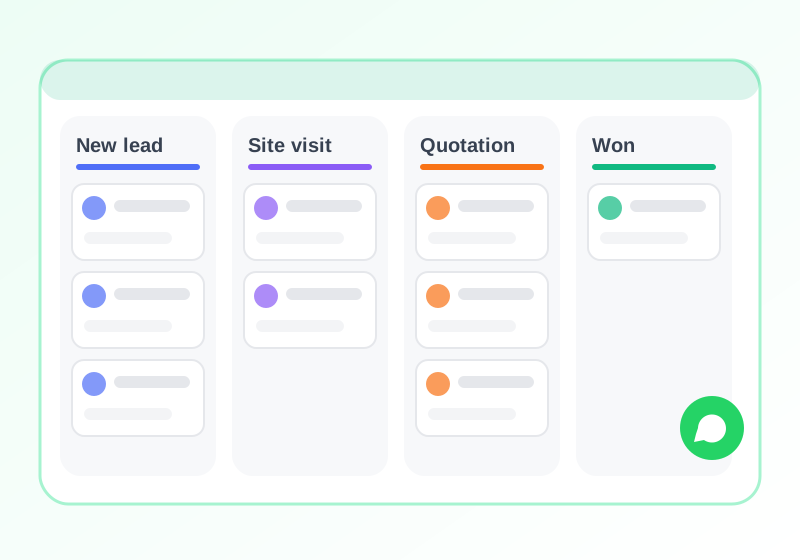
The Excel and WhatsApp problem every growing business hits
It starts out fine. You've got an Excel sheet for enquiries, a WhatsApp group for the sales team, Tally for invoices, and the owner's memory holding the whole thing together. At ten enquiries a day? Honestly, that's enough.
At fifty a day it falls apart. Two telecallers ring the same lead, and a salesperson quits and walks off with three years of customer chats on his personal phone. Ask how many IndiaMART leads actually bought last month and nobody knows.
Next step for most owners is an off-the-shelf CRM, and sometimes that works. Other times the team plays along for two months, and then one Monday you notice everyone's back on the Excel sheet. Why does that happen? Because that CRM was designed around a Western sales process, and yours has site visits, sample dispatch, rate haggling on WhatsApp or a yearly AMC renewal. A CRM nobody fills in is just a monthly bill.
Custom goes the other way round. Your real process becomes the software, and the screens use the same words your team already says out loud.
What we build into a custom CRM
Your mix won't look like anyone else's. These are the ones Indian SMEs ask for most, and we'd build whichever two or three cause you the most grief first.
Lead capture from every source, automatically
Nobody should be typing leads in by hand. Website forms post straight in, IndiaMART leads get pulled every few minutes, and Facebook lead ads arrive within seconds. We tag each one with where it came from and match the mobile number against what's already there, because nothing annoys a buyer like three calls from three of your people in one afternoon.
Pipelines that match your real stages
If your stages are "enquiry, sample sent, rate finalised, PO received, dispatched", then that's what the pipeline says. You decide when reminders fire (two days after a quote goes out is a popular one). If a lead's been gathering dust for a week, your manager hears about it.
Quotations and GST invoices
Picture your salesperson choosing a few products on her phone. The CRM checks your price list, stops her going past the discount limit you've set, and sends a PDF quote in your own letterhead over email or WhatsApp. When the customer says yes, that same quote turns into a GST invoice, HSN codes and CGST, SGST or IGST split already sorted. On e-invoicing? It can generate the IRN through a GST Suvidha Provider too.
Tally integration
Sales live in the CRM. Accounts live in Tally. Nobody should be retyping one into the other. The sync means your salesperson sees a customer already owes Rs 2 lakh before promising more credit.
Roles and permissions
Telecallers see their own leads, managers their branch, and the owner sees the lot. Margins stay hidden from anyone who doesn't need them.
Mobile app for field staff
Reps and service engineers get a phone app to check in at visits with GPS, add photos and notes, and log expenses. It works offline too.
Reports the owner actually reads
Which source brings buyers? Where do deals get stuck? We put that on one screen, plus a 9 AM WhatsApp summary to read with your morning chai.
How does a CRM with WhatsApp integration work?
In plain words, a CRM with WhatsApp integration hooks into the official WhatsApp Business API via an approved provider. Customers chat with your business number like they always have, and on your side every message quietly gets filed under the right lead. Your telecaller types replies inside the CRM. If she leaves next year, the chats don't leave with her.
There's room for a bit of automation as well. Somebody fills in an enquiry form at 11 PM? They get your brochure on WhatsApp before they've put the phone down. Messages outside the 24-hour window need approved templates and opt-in, which we track. What we won't touch is those unofficial tools that scrape WhatsApp Web. Numbers using them get banned, and then your sales line's just gone.
Industry examples: real estate CRM and other common builds
These are typical setups, not client stories.
Take a real estate CRM. A builder on SG Highway wants every tower, floor and flat in front of him, marked free, on hold or booked. Whether a lead came from 99acres, MagicBricks or a Meta ad, it drops into one queue, his sales team confirms site visits on WhatsApp, and every flat has its broker commission and payment schedule attached. How's Tower B doing? Twelve unsold. One screen, no phone calls.
Manufacturers and exporters? Their deals take ages. Enquiry, technical back-and-forth, sample, quote in rupees or dollars, PO, production, dispatch. IndiaMART and trade fairs bring in most of their leads, and I can't remember the last one who didn't want Tally sync.
Coaching classes have their own chaos: ad enquiries and walk-ins, counselling calls, demo lectures, admissions and fee instalments to chase. We'd set it up so counsellors get judged on admissions, because call counts are easy to pad.
Service and AMC people (HVAC, water purifiers, lifts, solar, CCTV) live and die by their installed base. Warranty ending when, AMC due when, which engineer went last and what parts he fitted: the CRM keeps all of it, and renewal reminders go out on their own. Frankly, that's often where the money is.
Custom CRM vs Zoho, Salesforce and HubSpot: which costs less over five years?
Small team, ordinary sales process? Zoho or HubSpot will almost certainly be cheaper for you, and I'd say so to your face. It's when you've got a bigger team, or a long list of Indian integrations, that custom starts winning over five years.
| Custom CRM | Zoho CRM | Salesforce | HubSpot | |
|---|---|---|---|---|
| Best fit | Unusual processes, many users, heavy Indian integrations | Small Indian teams with a fairly standard sales process | Larger companies with an in-house admin and consultant budget | Inbound marketing led businesses, often selling abroad |
| Per-user fees | None; one-time build plus optional support plan | Monthly per user, rising by edition | Monthly per user, among the highest | Free tier, then paid seats; marketing tools priced separately |
| Data ownership | Your server and your database | Zoho's cloud, with export | Salesforce's cloud, with export | HubSpot's cloud, with export |
| Customisation | Anything, since it is your code | Good: custom modules, fields and Deluge scripts | Very deep, but needs certified admins or developers | Moderate; easy to use, harder to bend |
| IndiaMART, Tally, GST | Built to your exact need | Available through extensions and Zoho Books | Mostly paid apps or custom work | Mostly third-party apps |
| 5-year cost picture | Highest in year one, then mostly support | Low to start, grows with every user | High, and grows with users and add-ons | Low at the start, steep once you need paid tiers |
Here's the five-year sum (illustrative numbers, not anybody's price list). Say you've got twenty users and you're paying Rs 1,500 each per month. That's Rs 30,000 gone every month, so Rs 3.6 lakh a year and a cool Rs 18 lakh over five, and that's before any add-ons or price hikes. A custom build for the same team might be Rs 4 to 8 lakh plus a yearly support plan, and user number 21 costs you nothing. With five users the maths flips, and I'd tell you to go with Zoho.
Price is only half of it, mind. The other half is whether your team will actually use the thing.
When should you NOT build a custom CRM?
When a standard CRM covers most of your process and your team's small. We'd rather lose the job than build something that gets abandoned. My honest list of reasons to wait:
- You've got fewer than about ten users and a pretty normal sales process. Zoho or HubSpot will do.
- You've never used a CRM. Try three disciplined months on an off-the-shelf tool first.
- Nobody inside will own it. Somebody in the office has to be the person who nags when the data's wrong, or it slowly rots.
- Your process keeps changing every month, so let it settle first.
- The real problem is your team doesn't follow up. Software can remind someone to call, but it can't make them pick up the phone.
How we build a custom CRM
- First, process mapping (1 to 2 weeks). We sit down with the owner, a telecaller and someone from accounts and draw out every stage of a real deal, messy exceptions and all. You get a written scope and a fixed quote at the end of it.
- Then a clickable prototype, another 1 to 2 weeks. We mock up the main screens in Figma for the people who'll use them daily, because telecallers spot problems owners never would.
- Phase one build takes 4 to 6 weeks. Leads, pipeline, follow-ups and basic reports go live first because that's where it hurts, and you'll see a working demo each week.
- Next we move your data in. Old Excel sheets and contacts get imported, duplicates cleaned out by mobile number, and old statuses mapped onto the new stages.
- Phase two adds quotations, GST invoices, Tally sync, the mobile app and WhatsApp automation, in whatever order pays off soonest for you.
- Last comes training by role (recorded), a written guide, and support if you'd like it.
Under the hood it's boring, proven tech (ASP.NET Core or Node.js, React, PostgreSQL or SQL Server), so any decent CRM software development company could pick up our code later.
Who owns the CRM, and where is it hosted?
You do, outright: source code, database and hosting account. The code lives in a repository under your company's account and we work in it as invited developers. Where it runs is up to you. AWS or Azure in Mumbai is the usual pick, an Indian cloud provider suits some people and a few owners still want a server in their own office.
One legal point worth knowing: your customers' names and numbers are personal data under India's Digital Personal Data Protection Act. That's why we put in role-based access, login records, encrypted backups and a way to delete someone's data when they ask, right from the start.
Do you build custom CRMs for companies outside India?
We do, for businesses in Australia, the UK, the USA and the UAE that want what our Indian clients want: a CRM shaped around how they sell, with no per-user fees. The integrations change, of course. Instead of IndiaMART and Tally it's usually Xero or QuickBooks, Stripe, your web forms, a calling tool, or the WhatsApp Business API, which a lot of Gulf businesses live on.
What overseas clients ask about first is the paperwork, and fair enough. We sign your NDA before the process-mapping call. The development agreement assigns all IP in the code to your company, the repository and cloud accounts are in your name from day one, and the data can be hosted in your region (AWS in Sydney, London or the US, or Azure in the UAE) if your privacy rules or your customers want it kept there.
Time zones are easier than people fear. Our 10 AM to 7 PM IST day covers the Australian afternoon and the UK morning, and the UAE is just 90 minutes behind. US clients get their weekly demo early or late in the day, and the build keeps moving while they sleep.
Pricing is a custom quote after scoping, in US dollars. Our fixed overseas packages for websites, SEO and ads are on the pricing page.
How much does a custom CRM development company in India charge?
If all you need is leads, follow-ups and reports for one team, custom CRM development in India typically starts from Rs 1.5 lakh. Add quotes, GST invoicing, Tally, a field app and WhatsApp, and it's more like Rs 4 to 8 lakh. And if you've got several branches or a dealer network, it'll be more again.
Time-wise, plan on 6 to 10 weeks before your team's using a first version. We then grow it over three to six months. By month three your team has told us what they actually need, and it's rarely what anyone guessed. After that, we're on a yearly support plan for fixes and server health.
Frequently asked questions
How much does custom CRM development cost in India?+
From about Rs 1.5 lakh, typically, if it's just leads, follow-ups and reports. Once you add quotes, GST invoicing, Tally, WhatsApp and a phone app, most of ours have ended up in the Rs 4 to 8 lakh range. You won't get a surprise bill, though. We fix the price after mapping your process with you, before a line of code exists.
How long does it take to build a custom CRM?+
Six to ten weeks for a first working version, give or take. Because we release in phases, your team's using leads and follow-ups while quotes, Tally sync and the app arrive later. The whole system takes three to six months, with a clickable demo every week.
Is a custom CRM better than Zoho for a small business?+
Honestly? Often it isn't. With a small team and a normal process, I'd send you to Zoho myself. A custom CRM for small business only pays off when Zoho can't handle some step you rely on, when you've got enough people that per-user fees start to sting, or when IndiaMART, Tally or WhatsApp need to be wired in deep.
Can a custom CRM integrate with the WhatsApp Business API?+
It can, as long as it goes through an approved provider of the official API. Your people chat with customers from inside the CRM, and the whole thread sits under that lead for anyone to read later. Reminders and brochures can fire off on their own using templates WhatsApp has approved. We avoid unofficial WhatsApp Web tools, since they get numbers banned.
Can the CRM capture leads from IndiaMART, Facebook and our website automatically?+
That's usually the very first thing we switch on. Leads from website forms, IndiaMART, Facebook and Instagram lead ads, and most property or listing portals flow in without anyone typing. We label where each came from and catch duplicates by mobile number. A month in, you'll know which source sends buyers and which just sends tyre-kickers.
Can a custom CRM sync with Tally?+
It can, through TallyPrime's XML interface. We push ledgers and sales vouchers into Tally and pull outstanding balances back, so sales can check who owes what before taking another order. Nobody retypes invoices.
Who owns the source code and the customer data?+
Both are yours. We keep the code in a repository on your company's account, the database lives on hosting registered to you, and once the final payment's in, ownership is fully yours. If we ever part ways, you walk off with all of it, plus the documentation your next developer will want.
Can our field sales team use the CRM on their phones?+
They can. We'll give them either a mobile app or a progressive web app, whichever suits. A rep reaching a factory in Sanand checks in with GPS, snaps a photo, jots notes, makes a quote and logs his petrol bill. No signal inside the shed? It saves offline and syncs once he's back on the road.
Can you move our old data from Excel or another CRM?+
Yes, and since nobody enjoys this bit, we do it. Send the Excel sheets, or whatever Zoho or HubSpot lets you export. We strip the duplicates (the mobile number gives them away), match your old statuses to the new stages and show you a trial import before anything's final. Your old files? Left exactly as they were.
Will you sign an NDA and hand over the IP if we're an overseas company?+
Both, and before you've told us anything you'd mind a competitor hearing. Your NDA or ours, whichever your lawyer prefers. On final payment the agreement hands every bit of IP (code, designs, docs) to your company, and if your lawyer wants to mark it up, that's fine by us. The code lives in your GitHub from the first day anyway, so there's nothing we could hold back even if we wanted to.