
We're Digital Web Mania, a SaaS development company in India based in Ahmedabad, and we get founders from idea to launched MVP. First comes a scoping sprint and a prototype you can click. Then we build it in React or Next.js on ASP.NET Core or Node.js, new version every Friday. Multi-tenancy, billing and an admin panel come as standard.
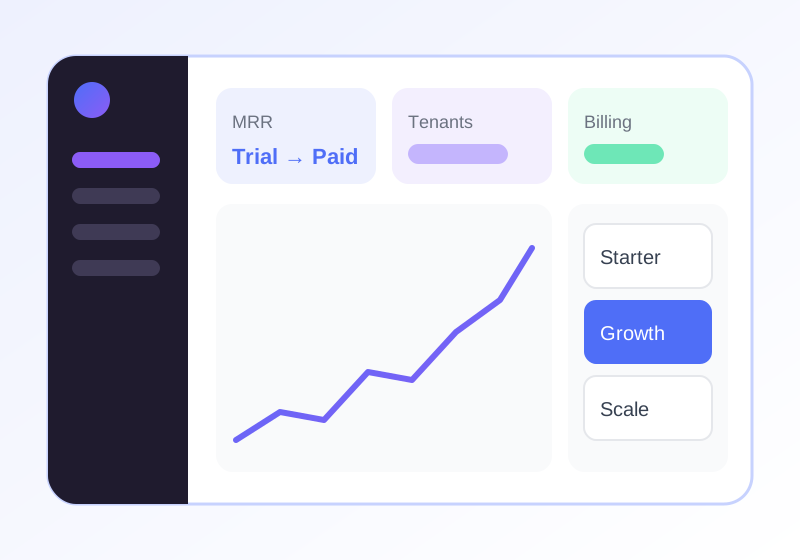
Why most SaaS products fail: they build too much
Want to know what usually kills a SaaS product? It's not bad code. I've watched founders spend a year building their whole wishlist, launch with a big LinkedIn post, and then hear nothing. The money's gone by then. And the thing that would've saved them, sitting down with ten customers before writing any code, never happened because everyone was too busy building.
The ones that make it tend to start embarrassingly small. One kind of user, one problem, one workflow done properly. They ship in weeks, not years, and change based on what real people do instead of what the founder imagined. Billing goes in from day one, because "people say they like it" and "people pay for it" are completely different signals.
So that's how we do SaaS product development. Honestly, most of our job in the first few weeks is cutting. A founder walks in with 40 features and the MVP needs maybe eight. The rest go on a later list, and about half of those never get built, because once real users show up they ask for something else entirely.
How we work as a SaaS development company in India: four stages
1. Scoping sprint (1 to 2 weeks)
It's a few sessions, sometimes on a whiteboard and sometimes over far too much tea. Who's your very first customer? How do they cope today? What would make them reach for their wallet? Once that's clear, we trim the idea to the smallest thing that does that one job, and put it on paper as user stories and a list of screens. You walk out with a fixed quote and dates.
Got a fatal flaw hiding in the idea? Better it shows up now, when it costs you two weeks rather than ten lakh. And the scoping document is yours. Show it to any other MVP development company you like.
2. Design prototype (2 to 3 weeks)
Then our UI/UX folks build it in Figma. It's only a mock-up, but you can tap through it on your phone and it feels real enough. You can take that to prospects before we've written any code at all. I've seen founders come back from those meetings with signed letters of intent and even pre-orders, which tells you far more than a Google Form survey ever will.
3. Build with weekly demos (6 to 12 weeks)
Every Friday you get a link to a build you can actually click through. No status report full of percentages. Monday we agree what's next, Friday we show it. Changed your mind after seeing something? Fine, it goes in next week's plan, no drama. And billing, emails, admin and security grow with the product rather than getting rushed in at the end.
4. Launch and iterate
Launch day isn't a big bang. We let in a small group first (your waitlist, or two or three pilot customers), sit back and watch where they get stuck, and fix it. Analytics are on from day one, so data settles arguments, not whoever shouted loudest. Then it's a monthly retainer, as fast or as slow as your budget likes.
Which tech stack should a SaaS product use?
For most SaaS products, we'd say React or Next.js on the front, ASP.NET Core or Node.js on the back, and PostgreSQL for the data. It's safe and proven. If those words mean nothing to you, don't worry, I'll go through them one at a time.
Front end means the screens your users tap on. We build those in React, or Next.js if you've also got pages (pricing, help articles) that need to show up on Google.
The backend is where your rules live. Who's allowed to see what, what happens when a payment fails, how a report adds up. We reach for ASP.NET Core when the product's business-heavy, sells to bigger companies or has to sit nicely with Microsoft systems. Node.js wins when there's lots happening in real time (live chat, notifications, people editing together), or when the team you'll hire later is going to be JavaScript folk.
Your customers' data sits in the database. We default to PostgreSQL because it costs nothing, it's fast, and a feature called row-level security makes it much harder for one customer's data to bleed into another's. Microsoft shop? SQL Server, then.
Hosting is where it runs. AWS and Azure both have Indian regions, which matters if you sell to government, banks or hospitals that need data kept in India.
We go boring on purpose. React, .NET and Node developers are easy to hire in India, and you'll be thankful for that on the day you build your own team.
What every SaaS product needs on day one
A lot can wait until after launch. These can't, because adding them later costs roughly three times as much and usually means moving data around while paying customers are using the thing.
Multi-tenancy
Multi-tenant SaaS development just means one app serves lots of customer companies, and each company's data stays completely separate. What's the worst thing that can happen to a SaaS business? One customer seeing another customer's data. Usually we use a shared database with a tenant ID on every record, plus PostgreSQL row-level security as a second lock, so one sloppy query can't leak data between accounts. If an enterprise customer insists on their own database, they can have one.
Roles and permissions
Owners, admins, regular users, read-only people. Each sees only what they should, and customers manage their own teams without emailing you.
Billing and subscriptions
You'll want plans, free trials, upgrades and downgrades with proration, GST invoices, and automatic retries plus reminder emails when a payment fails. For Indian customers we use Razorpay Subscriptions, which handles UPI AutoPay and card mandates under RBI's recurring payment rules. Selling abroad? Then it's Stripe, if your company can get an account. We check that in week one, since Stripe has restricted Indian onboarding at times.
Audit logs
A record of who changed what, and when. Bigger customers ask about it on sales calls. It also settles arguments the day a user swears blind they never deleted that record.
Onboarding emails
Three emails, basically. Welcome. Then a gentle poke on day two if they've not finished setting up, and a warning before the trial runs out. Boring? Sure, but they'll often do more for your trial-to-paid numbers than whatever feature you were itching to build next.
Admin panel
Your own back office. See every customer account, change plans, issue refunds, and log in as a user to see exactly what they're seeing when they need help (with that logged, naturally).
Security
Hashed passwords, two-factor login, rate limits on login and API endpoints, secrets kept out of the code, encrypted backups, and a pass against the OWASP Top 10 before launch. We also plan for India's Digital Personal Data Protection Act from the start, so consent and deletion requests have a proper home inside the product.
Can an internal tool become a SaaS product?
Often, yes, and it's one of the better-tested ways into SaaS, because the tool already solves a real problem for at least one business: yours.
Just don't underestimate the jump. Your internal tool only has to suit your company, and when something breaks, your staff walk over to the developer's desk. Strangers paying for it won't do that. They'll want to sign up on their own, pay online, set it up their way, find answers in help docs and never need to phone you. Under the hood that means multi-tenancy and billing too.
My advice before you rebuild anything? Find three other companies willing to pay for a pilot. If they won't pay for the rough version, polish rarely changes their minds. If they will, we'll go through your code, keep what's worth keeping, and convert it bit by bit while your own team carries on using it.
How much does SaaS MVP development cost in India?
Expect SaaS MVP development in India to cost you something like Rs 4 to 15 lakh, typically. Why such a range? Mainly because of how many kinds of user, workflows and integrations you want in version one. Anyone giving you an exact figure before scoping is guessing. Most products land in one of these three tiers.
| Tier | What it usually includes | Typical cost | Typical timeline |
|---|---|---|---|
| Lean MVP | One user type, one core workflow, basic roles, Razorpay subscriptions, onboarding emails, simple admin panel | Rs 4 to 6 lakh | 8 to 10 weeks |
| Standard MVP | Two or three user types, team accounts, multi-tenancy, dashboards, two or three integrations, audit logs | Rs 6 to 10 lakh | 10 to 14 weeks |
| Complex MVP | Marketplace or workflow-heavy product, several integrations, mobile app or PWA, advanced reporting, stricter compliance needs | Rs 10 to 15 lakh | 14 to 20 weeks |
Bear in mind the build price doesn't cover running costs. Set money aside for hosting, an email service, monitoring and gateway fees (about 2 percent per transaction on Razorpay's standard plan). And please, keep a marketing budget. A launched product nobody's heard of is the most common way we see founders run out of cash.
How long does it take to build a SaaS MVP?
Most SaaS MVPs take 10 to 16 weeks from the start of scoping to the first paying users. You get speed by cutting scope, not corners, and security and billing are never the corners we cut. Scoping plus the prototype is roughly a month, and the build runs six to twelve weeks after that. Where do the long delays come from? Usually the founder's side, if I'm honest: decisions that sit for a week, payment gateway approval, or landing page copy that nobody's written. We flag those early.
Who owns the code and the intellectual property?
You own all of it. Before you tell us the juicy details, we sign your NDA. Then the development agreement says, in plain terms, that the code, designs and docs all belong to your company. From day one the code goes into a repository in your own GitHub or GitLab organisation, and the cloud accounts are in your name. We also list every open-source licence, because investors' lawyers will ask.
Do you build SaaS products for founders in Australia, the UK, the USA or the UAE?
We do, and the process doesn't change: scoping sprint, clickable prototype, Friday demos. What overseas founders want settled first is protection. So we sign your NDA before the scoping call, the development agreement assigns all IP in the code, designs and docs to your company, and everything lives in your own GitHub and cloud accounts from the first commit. Raising money later? That clean paper trail saves you an awkward week in due diligence.
The product shifts a little. Billing runs on Stripe in USD, GBP, AUD or AED rather than Razorpay. Tax means VAT or US sales tax, and privacy means GDPR rules for UK and EU customers. Hosting goes in the region your buyers are in.
Then there's the clock. Our 10 AM to 7 PM IST day overlaps the Australian afternoon and the UK morning, and Dubai is 90 minutes behind us. For US founders we hold the weekly demo early or late in their day, and the nice side effect is that the build moves while they sleep.
Pricing is a custom quote after scoping, in US dollars. Our pricing page lists the fixed overseas packages for websites, SEO and ads that often sit alongside a launch.
What happens after launch?
Usually the founder keeps us on a monthly retainer, and they set the speed. Bugs get fixed, security stays patched, someone watches the servers, and there's a block of hours each month for new features. Fresh funding? Turn it up. Busy selling? Turn it down.
Sooner or later a lot of founders want their own developers, and I think that's the right instinct. Any SaaS development company in India worth hiring should make that easy. We write proper docs, walk your new people through the code and sit with your first hires for as long as it takes.
Frequently asked questions
How much does it cost to build a SaaS MVP in India?+
Typically you're looking at Rs 4 lakh at the low end and up to 15 lakh for the heavier builds. Keep it to one type of user doing one job and you'll stay near the bottom. Add more user types, a pile of integrations or a mobile app and it climbs. After scoping you'll have a fixed number in writing, and honestly, do show that scope around to other developers.
How long does it take to build a SaaS MVP?+
Usually ten to sixteen weeks, if we start the clock at the first scoping session. Scoping eats a week or two, design another two or three, and building six to twelve, with something to click every Friday. Simple products can go live in around eight weeks. The complicated ones can stretch to twenty.
Do I own the source code and intellectual property?+
Every line of it. The development agreement hands full IP in the code, designs and documentation to your company. Your code sits in your own GitHub or GitLab account from day one, and hosting's in your name as well. Nothing's held back, and you'll never pay us a licence fee for using your own product.
Will you sign an NDA before I share my SaaS idea?+
Happily, and before you tell us anything detailed. Use yours or ours. Between us, though, I've never seen an idea succeed or fail because someone copied it; it's the building and the selling that decide it. But you should feel relaxed sharing, so sign we will.
Can you build a multi-tenant SaaS with subscription billing?+
We'd be surprised to build one without it. Every record carries a tenant ID and the database itself checks it, so customers can't peek at each other. On billing you'll get plans, trials, upgrades, GST invoices and a polite nudge when somebody's card bounces. Razorpay with UPI AutoPay covers India; Stripe handles overseas buyers if they approve your company.
Which tech stack suits a SaaS product?+
We'll nearly always suggest React or Next.js, ASP.NET Core or Node.js, and PostgreSQL. Nothing fancy, and you'll find developers for all of it in any Indian city. Selling to enterprises? We'd lean .NET. Lots of live, real-time stuff? Node. Either way we'll talk it through in normal language before anything's decided.
I'm a non-technical founder. Can I still work with you?+
Of course. Plenty of founders who call us couldn't tell you what an API is, and they don't need to. Scoping's all about your customers. You'll click around the prototype before anything's built, and every Friday there's a new version to play with. When a technical choice comes up, we'll put it to you as money, risk and weeks.
Can our internal business tool become a SaaS product?+
Quite often, yes. Think about it: it already fixes one real problem, yours, and most ideas can't say that. You'll need to bolt on a few things first (separate customer accounts, sign-up without a phone call, billing, a gentler first-day experience). My rule of thumb, though? Get two or three companies paying for a pilot first. Then we'll look at what code survives.
Do you work with SaaS founders outside India?+
Yes. It runs on video calls, a shared Figma board and a project tracker, and honestly it works fine. We're in from 10 AM to 7 PM IST, Monday to Friday, so Sydney gets our mornings in its afternoon, London gets us in its morning and Dubai barely notices the gap. US founders? Early or late demo, your pick. We invoice in dollars and sign your NDA and IP paperwork before you tell us anything that matters.
What happens after the MVP launches?+
Usually we stay on, paid monthly, fixing bugs, patching, watching the servers and building a few new things with the hours left over. Raise money and you can turn that up; hit a quiet patch and turn it down. And when you're ready for your own developers, we'll hand over the docs and sit next to them until they don't need us.